What Gender Really Means in Tarot
This is a topic that isn’t discussed nearly enough, and yet, is perhaps one of the most important. Of course, we can’t escape the fact that a lot of the tarot cards are gendered. Kings, Queens, Knights & Pages, even when modernised to the Mothers, Fathers, Sons & Daughters, have distinct gender attachments. Likewise, Major Arcana cards such as The High Priestess, The Empress, The Emperor, The Hanged Man - I could go on - are gendered figures.
The traditional Rider Waite Smith imagery, which most tarot decks are based upon, was originally illustrated in 1909 by Pamela Coleman Smith. Its imagery is not the most inclusive, which is unsurprising considering the context of the time it was created. Many people struggle to connect with it, understandably so, because the images don’t feel relatable and don’t ‘connect’ with them. Modern creators have adapted wording and created decks with more diverse representation, which is wonderful. But no matter how we change these cards visually, the gender associations with the traditional cards (and their traditional names) from The Empress to the King of Wands, can greatly impact the way we perceive them - and more importantly, whether we perceive their wisdom to be relevant to us at all.
And it’s easy to understand why. Historically, we interpreted these cards more literally than we do now. A King of Wands might have once been interpreted as a sign you’d marry a red-haired man, or The High Priestess might have indicated that an older woman was significant in your life. However, increasingly, tarot’s reputation is moving away from the deterministic predictor of fate, and more and more people are seeing the value in utilising the tarot as a facilitator of our personal growth. And so, a reader is now more likely to interpret these same cards as aspects of the individual they are reading for.
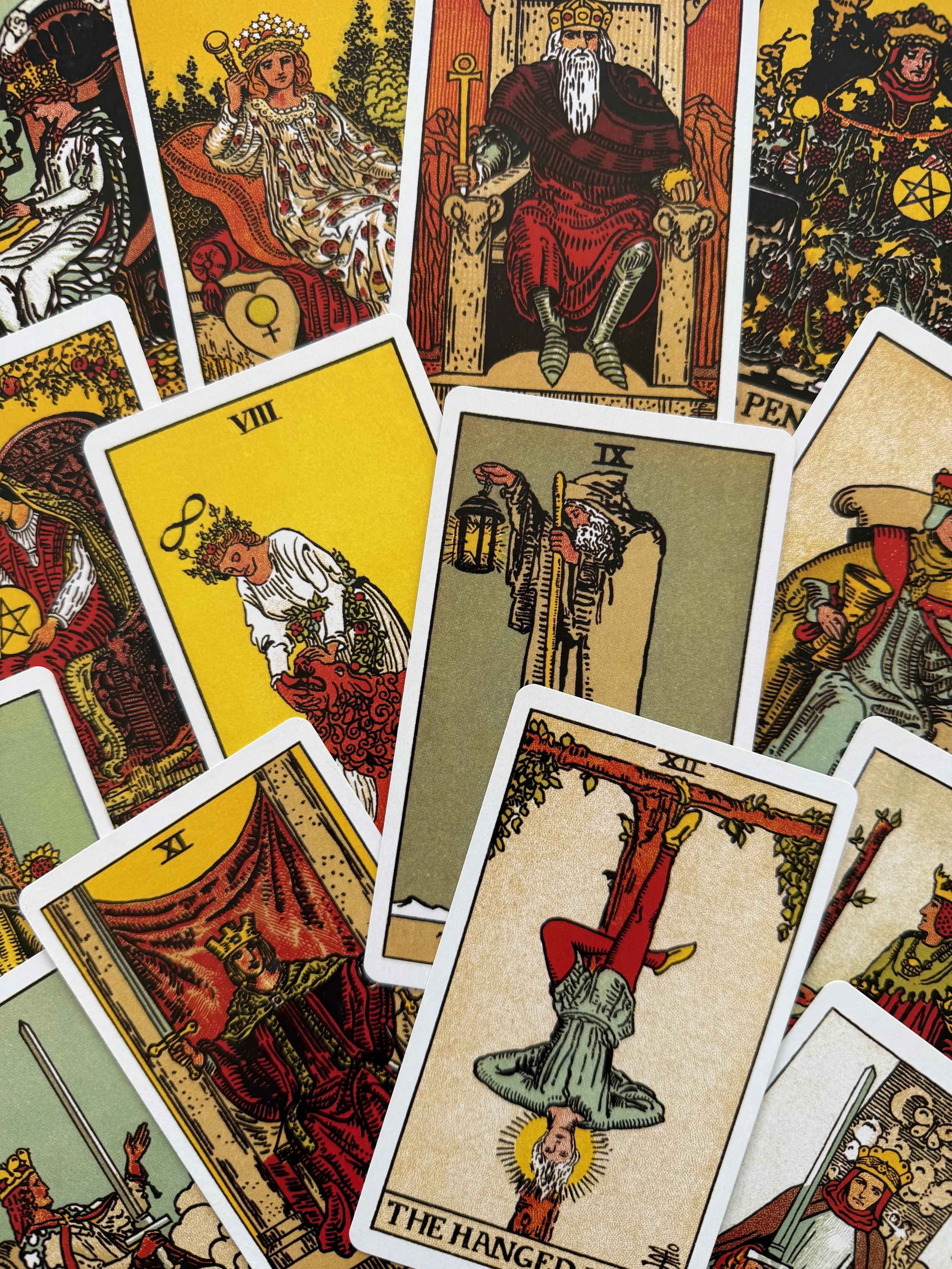
Because here’s the thing, all of us are capable of embodying and/or experiencing every single one of the 78 cards in the tarot deck.
The High Priestess’ intuition is not exclusively accessible to older women and the momentum of the Knights isn’t reserved for men under the age of 25. We can all embody and learn from these archetypes, no matter who we are. The age of these figures, and more importantly, the gender of them, has no bearing on your capacity to experience them.
Each of the 78 cards of the tarot deck has something to teach you - regardless of whether the person in the picture looks like you or not.
So, what does gender actually mean in the tarot deck?
In order to understand this, we have to first consider how we interpret the tarot cards in general.
Each of the cards in a tarot deck has an image on it, and each of those images holds symbolic meaning. We use clues in the images to interpret and understand that meaning.
And so things like age and gender give us information about what the card means symbolically in a sort of visual shorthand.
Age is a great example of this, so let’s start there as an example.
The Hermit is an older figure in the tarot deck, as is the grey-haired man that we see in the Ten of Pentacles. This visibly aged appearance is representative of their wisdom. Because wisdom isn’t something that we gain overnight. It takes time, and more importantly, experience, to gain wisdom. And what better way to depict time passing than visible aging?
But if we really think about it, age has nothing to do with wisdom. There isn’t a certain age threshold that we reach in order to be considered ‘wise’. Yes, it’s something that builds over time. But people can have great wisdom in one area of life and lack it entirely in another. Young people can experience things that lead to great wisdom early in life. Older people can lack the wisdom we expect from someone of their age.
Age does not mean wisdom, but the age of the figure in the card serves as a symbol for it, and that can apply to anyone, no matter who is sitting in front of you.
And gender is no different.
It is a visual shorthand for masculine and feminine energy. I know that the terms ‘masculine’ and ‘feminine’ can be difficult to separate from our understanding of gender, because the western world frequently uses these terms to define what a ‘man’ or a ‘woman’ should be. It can feel like we’re essentially talking about the same thing (and the fact that the visual reference point is gender, only serves to double down on this misconception). But that’s just it - it is a misconception to conflate gender with masculine and feminine energy. Rather, what tarot is highlighting with these terms is a duality that exists within all of us - and within all things. Two sides of the same coin, rather than two entirely different ones. The concept of Yin/Yang is similar - and on a very basic level, Yin is often associated with feminine energy and Yang, the masculine. In the tarot deck, The Sun is ascribed masculine energy and The Moon is its feminine counterpart.
When we see a man in the tarot deck, it is not representing ‘man’. Rather, it is indicating that the energy of the card is masculine in nature. For example, The Emperor’s orientation towards action and structure. Likewise, the women of the tarot deck express feminine energy, such as The Empress and her inclination towards creativity, nurturance and flow.
The Emperor and The Empress are great examples because they are such obvious representations of masculine and feminine energy, and because of the ways society relates these concepts to gender stereotypes and societal ‘norms’, they are most heavily associated with gender.
I have heard people who identify as women say they struggle to resonate with The Emperor, and likewise, those who identify as men with The Empress. When we get down to why that is, in part, it can be because their opinion of the card is loaded due to the gender of the image.
But just because society has ascribed a subset of traits to one gender, doesn’t mean it’s true. In fact, in reading for my clients and discussing these cards on a deeper level with my mentoring clients, I am repeatedly reminded of how universal these themes actually are. I have clients that identify as women who are much more comfortable embodying the structured energy of The Emperor, and likewise, those who identify as men that are naturally more creative and ‘go with the flow’, like The Empress.
And even still, when it is not our natural predisposition to be a certain way, we will still embody that energy at times - because we’re real people, and real humans aren’t one-dimensional characters or archetypes.
The creative artist embodies The Emperor to turn their passion into a business that makes them money.
The corporate head embodies The Empress when they implement new and innovative ideas.
The nurturing parent still lays down the law with their child when they need to.
The science geek has a passion for music.
The CEO might be terrible with numbers.
But the CFO might be great with people.
My examples might be somewhat reductive, but what I’m attempting to make clear here is that we are all walking contradictions - even the most ‘stereotypical’ among us. And at the heart of that is this duality of masculine and feminine energy that persists in us all.
Even the cards themselves invite us to reflect on this, with cards such as Strength and Justice being femininearchetypes. Strength is a word we associate, societally, with masculine energy, and so the card as a feminine archetype, teaches us something interesting about Strength. It challenges our very definition of the word. Perhaps strength doesn’t come from physical force and dominance (as society might have us believe). Rather, what if the strongest thing we can do is embrace our vulnerability? This is something that I discussed in the latest episode of my podcast, Major Arcana Energy. (If you’d like to listen, you can click here.)
There is so much to learn from each of these cards, and our gender identity should never be a barrier in accessing what they have to teach us.
In fact, perhaps one of tarot’s greatest lessons is that we are all so much more than the labels and boxes the world tries to fit us in.
Have you ever felt like a card ‘wasn’t for you’? Did you learn anything from it? Let’s talk about it in the comments!
N x