Tarot Doesn't Give You Answers. It Helps You Find Them.
We often come to the tarot when we’re seeking answers. We’re lacking clarity, certainty or direction. We don’t know what to do or which way to go. We don’t know if the path we’re on is right for us. And so we consult the cards.
As you can see, there’s a sense of discomfort behind these intentions. A sense that, even if we don’t know where we’re going, we can’t stay here.
And that, my friends, is Hermit energy. The wise old man on his slow journey through the dark, with nothing but the glow of his lantern to guide his way. His movement is inspired by a deep-seated discomfort, even if he hasn’t pinpointed exactly why yet.
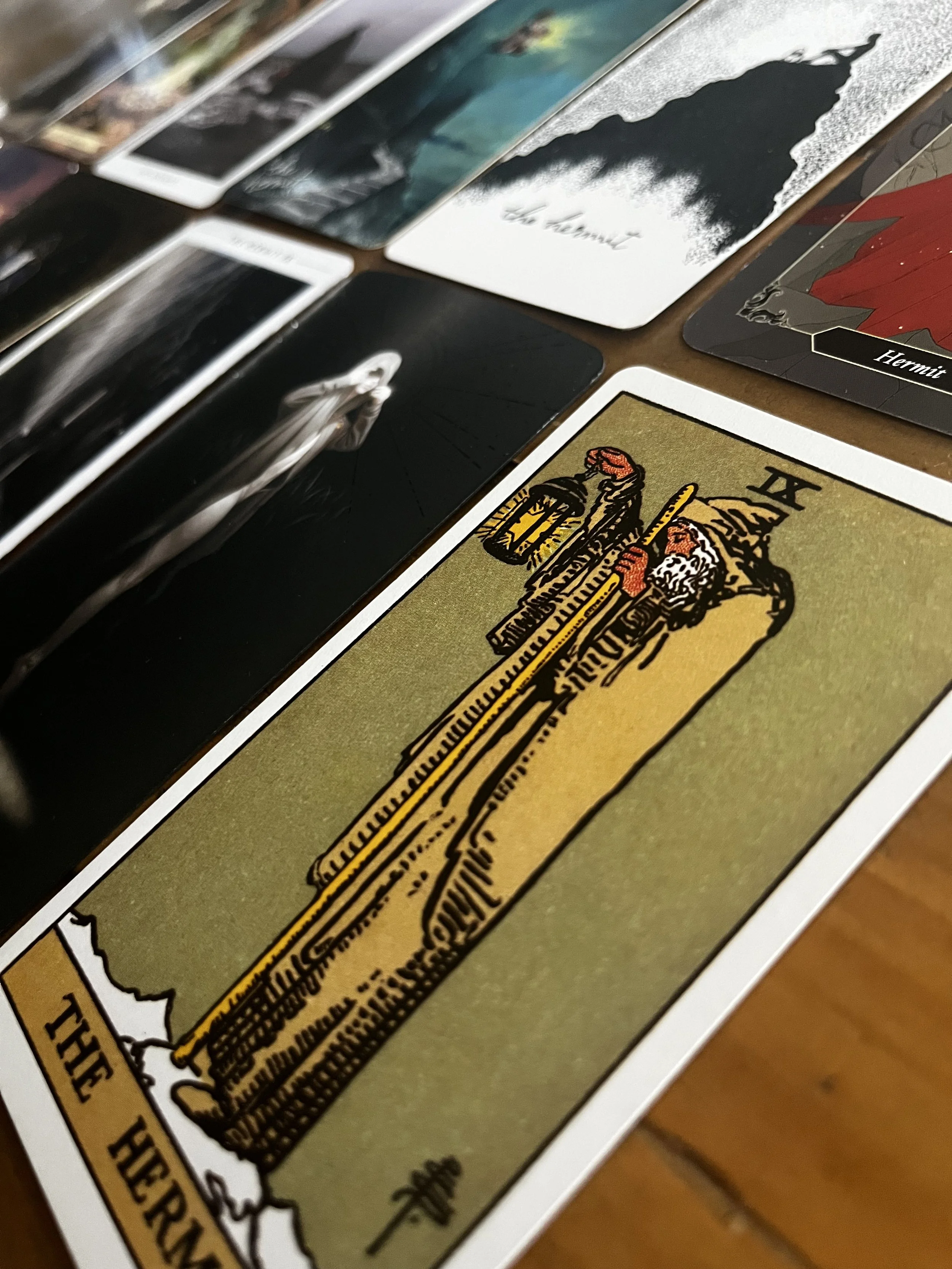
This isn’t the same sort of movement as that of The Chariot or the Knights - quick, intense and/or intentional movement, where we’re either bouncing off the walls or nothing can stop us. Rather, instead, this is a slow, deliberate, sometimes melancholy, exploration and excavation of the self, often resulting in outward changes.
This, in my opinion, is much closer to what a tarot reading actually is, than what most people believe it to be.
Because, as I began this post with, we come to the cards seeking answers. A lot of people expect that a tarot reading is going to tell them which direction they’re supposed to be going in, or how long they’ll have to wait before they meet the love of their life, whether they’re going to get the promotion at work, if it’s okay for them to quit their job and go travelling.
Give me permission. Choose for me. This is too hard.
And that’s right - most of the time, these situations are incredibly hard.
But that doesn’t mean you’re not capable of handling them. It doesn’t mean you’re incapable of figuring these answers out for yourself.
What a good tarot reading does is provide you with perspectives and insight about your circumstances, that help you uncover your own answers. It is the prompt that facilitates your journey to them.
In my opinion, it would be irresponsible for me, as a tarot reader, to tell you what you ‘should’ do (or whether something absolutely will or won’t happen), because my responsibility as a reader involves empowering you, the client, and more importantly, discouraging a feeling of dependency on readings.
A reading shouldn’t be a way to outsource responsibility for your life. It shouldn’t make you feel like you have no control over what happens to you. Rather, it should remind you of the power you do hold, encouraging you to think more deeply about what you can do to change or improve your life circumstances.
Because here’s the thing, that’s how we experience true growth and instigate real change.
Let’s use an example to contextualise this, and imagine a hypothetical client is stuck on whether to go for the promotion at work or quit their job to focus on their side hustle.
If the reading were to tell the client they ‘should’ do either thing (or worse, they ‘will’ do either thing), that person doesn’t need to contemplate why that is the right decision in order to action it.
But the decision is meaningless if we can’t rationalise why that is the better pathway for us to take.
Real life rarely exists on such a simple binary of, ‘this option is good’ and ‘that option is bad’. Rather, all options presented to us tend to present us with pros and cons that we need to weigh out to determine which is best. Moreover, the same choices are not equally weighted for all people, as everyone has different life circumstances and priorities.
In this example, perhaps the promotion offers the potential for greater financial stability and the side hustle provides the potential for greater fulfilment. Both of these things are positive. So the question becomes, what is more important to the client? What is their current priority?
As you can see, it’s impossible for a tarot reader to determine which of these options is ‘better’ for the client, because the answer to that question depends on what the client is prioritising at this time.
And that’s without going into the deeper contemplation of:
What does financial stability mean for the client?
What narratives around finances and work life are impacting their ability to make this decision?
How happy are they in their current job?
How much responsibility does the promotion come with and are they willing (and ready) to take that on?
What is their relationship with risk and safety?
Is there strong encouraging/discouraging input from loved ones that is making the client doubt their own judgement?
These are the sorts of themes that can be explored in a tarot reading, and contemplating these sorts of questions leads us to our own answers. Even better, we learn something about ourselves in order to get there, something that will benefit us long after the immediate situation is resolved.
The person seeking ‘permission’ to quit their day job and pursue their passion because they’re afraid their family won’t approve, and they hold limiting beliefs around how ‘real money’ can only be made in a 9-5, doesn’t need the decision to be made for them.
Peeling back those layers of fear and limiting beliefs, that person might realise that the answer to their question is glaringly obvious. What that person really needed to consider is, what was stopping them making that decision?
This kind of contemplation is what The Hermit represents. It’s what helps us better understand ourselves. But we have less and less time for contemplation and self-reflection. And this is something I talked about in this week’s podcast episode about The Hermit. Our world is so noisy and distracted, that we rarely have the opportunity to sit with our thoughts. We occupy our brains in every second of our day. We’re scrolling on our phone while we’re queuing, listening to a podcast while we drive and replying to messages before we go to bed.
And this is why, in my opinion, tarot readings are such a powerful tool for us - perhaps more so than ever before.
They force us to carve out the time to reflect.
Because in a world of shortcuts and quick fixes, where outsourcing is convenient, the one thing you shouldn’t be outsourcing, is your personal power.
There are no shortcuts to growth. But there are tools to help you facilitate your own growth.
Tarot happens to be my personal favourite. What’s yours?